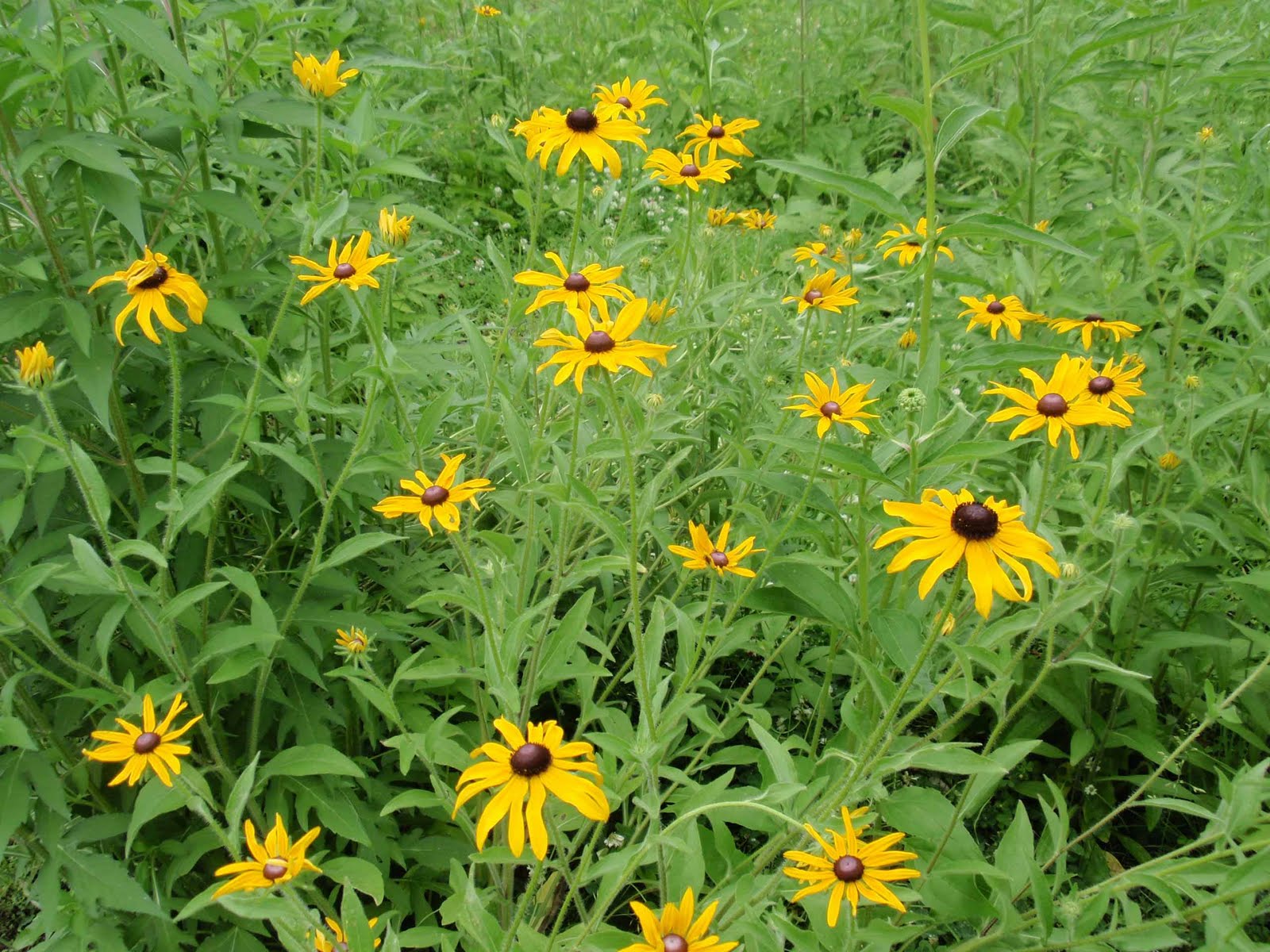
I took my husband with me when I walked out to the prairie this morning. I couldn't resist having a photo to mark brilliant sunshine on such a mass of yellow flowers. And they are gorgeous!
"Are they all yellow?" David asked. Sure looks like it, doesn't it? So far, they're all Black-eyed Susans, but more types of plants are close to blooming and they all look to be opening up yellow, too. Or so it seems on first glance.
Just this week, I spotted the first Purple Coneflower. A single purple bloom standing amidst all that yellow. How brave. How beautiful.
Since most of the plants are quite tall - at least the ones that appear close to blooming, I pick my way through the prairie, generally looking up. I look down in a sometimes futile attempt not to step on plants I've been trying to nurture.
On one such downward glance, I spotted another dot of purple. A plant I had not seen before and did not know by name. The distinct blossom of Purple Prairie Cover was easy to identify in my prairie flower book. Tucked in amongst the taller prairie plants (look closely; can you see it?), the clover - only a foot tall - would have been easy to miss if not for its purple flower.
This walk in the prairie reinforced an axiom I learned about nature during a walk in Alaska: it pays to look up, look down, look all around. The walk in Alaska involved a moose. But that's another story.
Friday, June 25, 2010
Thursday, June 24, 2010
A bouquet in one blossom
When I spotted this among the coneflowers in my patio garden, I didn't know quite what to think. The center cone is part of a purple coneflower, but only a part. Why weren't the long pink petals filling out the blossom? What is happening in this plant?
A blossom unfurling is a miracle to behold. And none more than coneflowers, as colors and textures and elements emerge. So this cornflower, stopping with only a cone was surprising. And puzzling.
A few days later, a friend joined me in a walk in my prairie, where Black-eyed Susans bloom in abundance. "Plenty of composites," she observed in passing. "Composites?" I asked. "What are composites?"
She shed a little light on the make up of flowers, if not on the circumstances surrounding my specific bloom, when she explained that each blossom of Black-eyed Susans and Purple Coneflowers and Sunflowers is actually made up of several different flowers - the 'cone' is one, each 'petal' another flower. Composite flowers have evolved so that each blossom is actually dozens, hundreds even, of flowers.
Come to find out, many flowers fall into the composite category: dandelions, asters, thistles, dahlias, to name a few. I wonder if the bees love my coneflowers so much because when they visit one blossom, they are enjoying the nectar of an entire bouquet?
Composite flowers are a clear demonstration of the old saying, "The whole is greater than the sum of the parts." A savvy man could take advantage of this knowledge when he gives his love a single flower- if he chooses the right bloom!
A blossom unfurling is a miracle to behold. And none more than coneflowers, as colors and textures and elements emerge. So this cornflower, stopping with only a cone was surprising. And puzzling.
A few days later, a friend joined me in a walk in my prairie, where Black-eyed Susans bloom in abundance. "Plenty of composites," she observed in passing. "Composites?" I asked. "What are composites?"She shed a little light on the make up of flowers, if not on the circumstances surrounding my specific bloom, when she explained that each blossom of Black-eyed Susans and Purple Coneflowers and Sunflowers is actually made up of several different flowers - the 'cone' is one, each 'petal' another flower. Composite flowers have evolved so that each blossom is actually dozens, hundreds even, of flowers.
Come to find out, many flowers fall into the composite category: dandelions, asters, thistles, dahlias, to name a few. I wonder if the bees love my coneflowers so much because when they visit one blossom, they are enjoying the nectar of an entire bouquet?Composite flowers are a clear demonstration of the old saying, "The whole is greater than the sum of the parts." A savvy man could take advantage of this knowledge when he gives his love a single flower- if he chooses the right bloom!
Labels:
bees,
black-eyed susans,
composite flowers,
Coneflowers,
evolution,
native prairie
Monday, June 14, 2010
Daisy fleabane & other native flowers
My prairie is awash in Black-eyed Susan Rudbeckia hirta. The seed mix sown a year ago must have been heavy in this species. They are brightening the prairie no matter where you look. Nothing else in the prairie appears close to blooming. But outside the prairie, we have much more.
Daisy fleabane Erigeron strigosus (right) and Yarrow Achillea millefolium (below), both members of the Aster family, line the fence along our western property line. The neighbors pastured their horses in another field this spring, so plants along the fence row have had an opportunity to take hold.
The more I spend time studying my prairie, the more I see Iowa's native flowers blooming everywhere. They've been around me all along. Now I just take the time to see them.
Labels:
black-eyed susans,
daisy fleabane,
Iowa prairie,
yarrow
Sunday, June 13, 2010
Coffin or casket? Does it matter?
Coffin or casket? Is there a difference? And if there is, does it matter? Until recently, I used these words interchangeably. But I learned by talking to Loren Horton, an expert on Victorian and early 20th Century funeral customs, that they're not the same thing.
A coffin was simpler in construction - a wooden box, unlined, with a one-piece lid that was removed for the viewing. A casket was more elaborate (and expensive), with lining that could have been pleated taffeta or satin. The lid was hinged and in two pieces, so the portion covering the upper body of the deceased could be opened for the viewing while the lower body remained cover.
Because of it's greater expense, a casket was intended to communicate that it was holding something more precious. A poorer family may only be able to afford a coffin. A family might choose a casket because they could afford it or because they wanted neighbors to think they could.
Other than interesting funeral detail, why does it matter? As I delve into writing historical fiction, I know that the details make the difference. History buffs can tell if a writer had done the necessary research. And the choice of the right detail can set a scene in time and place like nothing else.
The Living History Farm staged a Victorian Funeral this past weekend. Arriving early, I had the opportunity to question the 'widow' - a collector of funeral ephemera, herself - at length, learning about superstitions, clothing and mourning customs, and a host of other details. For instance, mirrors were covered because if you saw your reflection in the house in which someone died, you would die within a year. The widow wore black and was in mourning for two and a half years. Flowers were brought in to cover the smell - a particular issue in warm weather. The casket was always carried so the feet of the deceased went first - so the deceased could always see where he was going. And oh, so much more.
For me, the research is fun. I enjoy reading historical fiction because I'm always learning something. I find I enjoy writing historical fiction for that same reason.
Labels:
caskets,
coffins,
funerals,
historical fiction,
Iowa Summer Writing Festival,
Living History Farms,
research
Subscribe to:
Posts (Atom)